A2
We are to walk in God's ways and adopt them as our own.
Category: Godliness, Holiness & Righteousness
Type: Positive
Form: Explicit
Source dataset: Old Testament
Uniqueness: Unique
Classical commandment: Yes
New Covenant Literal Application
Applies to Person Categories: Everyone
 Jewish
 K'rov Yisrael
 Gentile
More explanation about the icons and New Covenant Literal Application
The New Covenant Literal Application Code (NCLA) is an interpretive guide used by the authors to indicate which person categories a mitzvah applies to, and at what level of literal compliance.
Each card above groups one application level such as mandated or optional. The three people icons show whether that application is meant for Jewish, K'rov Yisrael, or Gentile believers, and the male or female symbols show whether it applies to men, women, or both.
This code reflects the authors' interpretive opinion and is provided for prayerful consideration. The icon view is only a visual summary; the detailed codes and source explanation remain available below for careful study.
Detailed codes: GFm - Gentile female, mandated | GMm - Gentile male, mandated | JFm - Jewish female, mandated | JMm - Jewish male, mandated | KFm - K'rovat Yisrael female, mandated | KMm - K'rov Yisrael male, mandated

Bible references
Key NT Scriptures
- Ephesians 5:1
- John 10:27
- Luke 9:23
Key OT Scriptures
- Deuteronomy 10:12-13
- Deuteronomy 13:5
- Deuteronomy 28:9
- Psalms 25:4
Supportive NT Scriptures
- 1 John 2:6
- 1 Peter 1:14-16
Supportive OT Scriptures
- Leviticus 11:44
Bible verses copyright: PUBLIC DOMAIN except in the United Kingdom, where a Crown Copyright applies to printing the KJV. See http://www.cambridge.org/about-us/who-we-are/queens-printers-patent

Commentary
Rabbi Michael Rudolph
"Following" God, "imitating" Him, and "walking" in His ways are different ways of saying the same thing - learning God's ways and adopting them as our own. We see from the above Scriptures that this principle traverses both the Mosaic Covenant and the New Covenant, and that adopting the ways of Yeshua (who is more visible to us than the Father) assures us of adopting the ways of our Father in heaven as well. Yeshua Himself modeled this for us as we read His words in John 5:19 : Therefore, Yeshua said this to them: "Yes, indeed! I tell you that the Son cannot do anything on his own, but only what he sees the Father doing; whatever the Father does, the Son does too." There is a common misunderstanding that the Scriptures quoted in this Mitzvah should help dispel; the misunderstanding is that only through the indwelling of the Ru'ach HaKodesh brought by the New Covenant, can men succeed in obeying God. It is wrong because God never holds us accountable for that which we cannot do, and Scripture teaches that, at Mt. Sinai, God gave us instructions for conduct that He expected of us. On the other hand, to think that man on his own can accomplish God's will is wrong also, so what of the Spirit was available to man before the coming of the New Covenant? Since man in his own strength cannot fully accomplish God's will, it must be that the Holy Spirit was available at Sinai and before, but that the level of the Spirit's availability was limited and was greatly increased with the coming of the New Covenant. Jeremiah 31:32-33(33-34) partially explains this: "For this is the covenant I will make with the house of Isra'el after those days," says ADONAI: I will put my Torah within them and write it on their hearts; I will be their God, and they will be my people. No longer will any of them teach his fellow community member or his brother, 'Know ADONAI'; for all will know me, from the least of them to the greatest; because I will forgive their wickednesses and remember their sins no more." Jeremiah prophesies both the Messiah and the Ru'ach HaKodesh - the Messiah to provide a just means for God to forgive our sins, and the Ru'ach to implant God's very own nature within us in order to bring Him closer and assist us to walk in His ways. Ezekiel 36:24-27 also prophesies a New Covenant in which God would enhance our obedience through the Holy Spirit placed within us, yet God assured us in Deuteronomy 30:11-14 , that we were able to obey Him in pre-Yeshua times as well: For this mitzvah which I am giving you today is not too hard for you, it is not beyond your reach. It isn't in the sky, so that you need to ask, 'Who will go up into the sky for us, bring it to us and make us hear it, so that we can obey it?' Likewise, it isn't beyond the sea, so that you need to ask, 'Who will cross the sea for us, bring it to us and make us hear it, so that we can obey it?' On the contrary, the word is very close to you - in your mouth, even in your heart; therefore, you can do it!
Classical commentators
Meir and Maimonides agree with each other - that we are to model ourselves after God and expect to become like Him in nature. HaChinuch agrees, and references Micah 7:18 : Who is a God like you, pardoning the sin and overlooking the crimes of the remnant of his heritage? He does not retain his anger forever, because he delights in grace.
Copyright © Michael Rudolph and Daniel C. Juster, The Law of Messiah, Torah from a New Covenant Perspective, Volume 1 & 2

Drawings
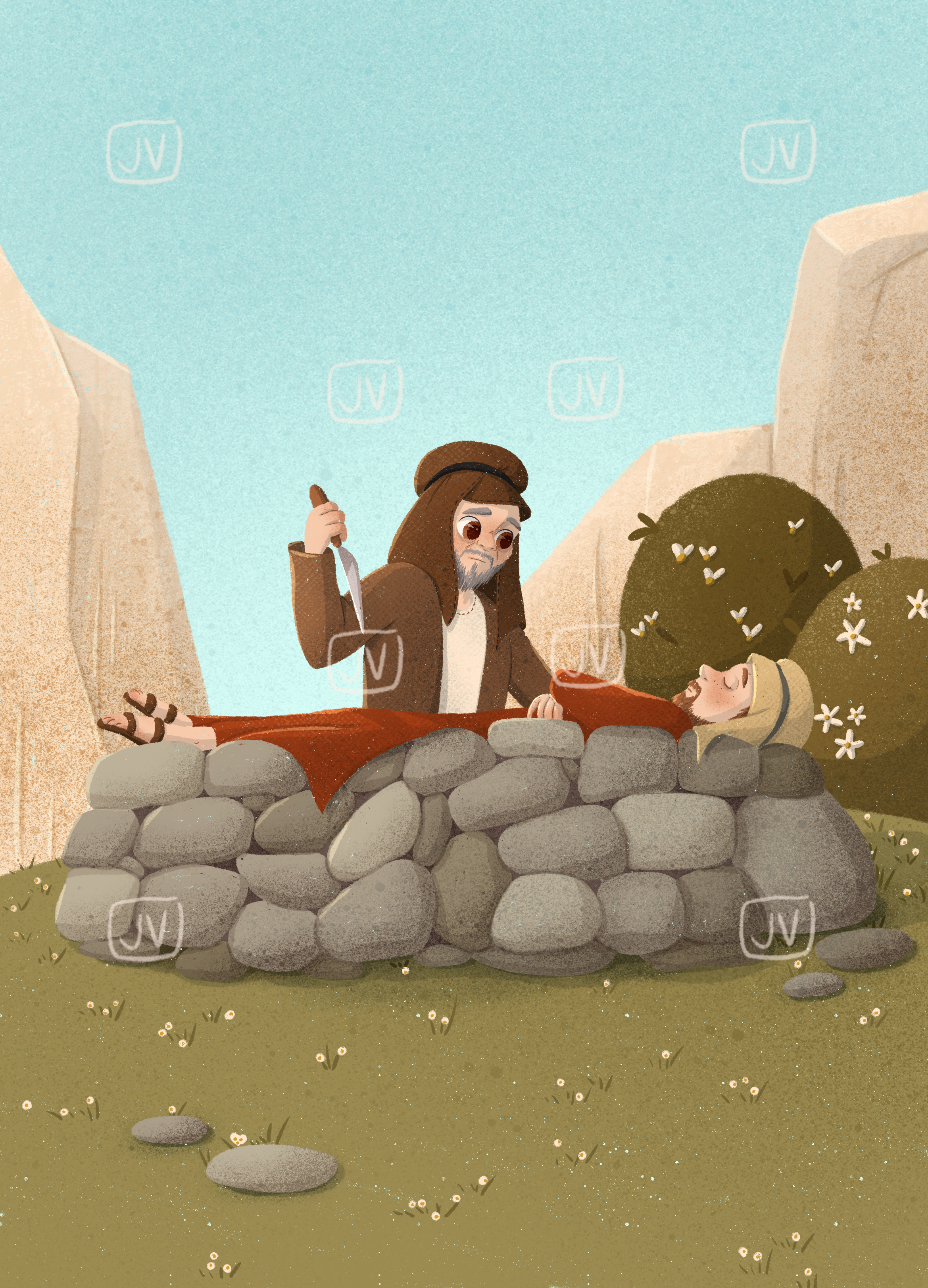
Artist: Jenske Visser

Songs
Sidewalk Prophets - Help me find it
Hillsong Worship - I surrender
Sanctus Real - Lead me
Jeremy Camp - My Desire

Testimonies
Moving Works - Gone
When Crystal Clapp gave her life to Jesus Christ, everything changed. Her thoughts became His thoughts. Her will became His will. The old was gone and, soon enough, so was she.

Classical Commandments
Maimonides
Maimonides (Rabbi Moshe ben Maimon, 12th century) organized all 613 Torah commandments into a structured list. These linked items show where this Law of Messiah commandment overlaps with that classical framework.
Meir of Rothenburg
Rabbi Meir of Rothenburg (13th century, Germany) was a leading Talmudic authority. These reference numbers link this commandment to his halachic rulings.
Source and License
Based on The Law of Messiah - Torah from a New Covenant Perspective by Michael Rudolph and Daniel C. Juster.
License: CC BY-ND 4.0 (Attribution required, NoDerivatives). CC BY-ND 4.0
Disclaimer: the original content is authored by Rabbi Michael Rudolph and Rabbi Daniel Juster; additional notes or implementation details on this website are not part of their original work and do not represent their views.
Record source: The Law of Messiah - Torah from a New Covenant Perspective - Volume 1 & 2
Copyright note: Copyright © Michael Rudolph and Daniel C. Juster, The Law of Messiah, Torah from a New Covenant Perspective, Volume 1 & 2