G14
We are to know that God exists and Who God is by observing His creation.
Category: God & Yeshua
Type: Positive
Form: Implied
Source dataset: Old Testament
Uniqueness: Unique
Classical commandment: No
New Covenant Literal Application
Applies to Person Categories: Everyone
 Jewish
 K'rov Yisrael
 Gentile
More explanation about the icons and New Covenant Literal Application
The New Covenant Literal Application Code (NCLA) is an interpretive guide used by the authors to indicate which person categories a mitzvah applies to, and at what level of literal compliance.
Each card above groups one application level such as mandated or optional. The three people icons show whether that application is meant for Jewish, K'rov Yisrael, or Gentile believers, and the male or female symbols show whether it applies to men, women, or both.
This code reflects the authors' interpretive opinion and is provided for prayerful consideration. The icon view is only a visual summary; the detailed codes and source explanation remain available below for careful study.
Detailed codes: GFm - Gentile female, mandated | GMm - Gentile male, mandated | JFm - Jewish female, mandated | JMm - Jewish male, mandated | KFm - K'rovat Yisrael female, mandated | KMm - K'rov Yisrael male, mandated

Bible references
Key NT Scriptures
- Romans 1:18-32
Supportive NT Scriptures
- James 1:17-18
- Luke 18:19
- Matthew 19:17
- 1 Timothy 4:4-5
Supportive OT Scriptures
- Genesis 1:1-31
- Nahum 1:7
- Psalms 25:8-9
- Psalms 86:5
- Psalms 100:5
- Psalms 106:1
- Psalms 119:68
Bible verses copyright: PUBLIC DOMAIN except in the United Kingdom, where a Crown Copyright applies to printing the KJV. See http://www.cambridge.org/about-us/who-we-are/queens-printers-patent

Commentary
Rabbi Michael Rudolph
Romans 1:19-20 says that godless and wicked people are without excuse for not knowing God because God's qualities (His eternal power and divine nature) are clearly seen in "what He has made". What He has made is another way of saying His creation. I am assuming that no one reading this Mitzvah is in the category of being godless and wicked or he would not very likely be reading it, so I will address my following remarks to those who are not yet convinced about God's existence, and to the rest of us who already know Him, want more of Him, and aspire to His virtues. Since what can be known about God (His existence and His nature) are there for all to see by observing His creation, then we are remiss if we do not seek to observe His creation at every opportunity. But how can Romans 1:19-20 make such a sweeping statement - that everyone, everywhere, can know about God merely by observing His creation? If we were to point to some item of God's creation and ask a typical unbeliever to explain how it could have come about without God, he would very likely respond with the Darwinism he had been taught - that it came about from organic compounds in the oceans that combined and, through natural selection, evolved to its present state. Now to me, the logic of that happening is so implausible as to defy imagination, but not to a person who has been taught that, and that has not yet had a personal encounter with God. I would fare no better were I to show the unbeliever what the Bible says about God because unbelievers do not believe the Bible either. Now the negative picture I have painted does not mean that I should not try, because (1) it is my obligation under the instruction of Matthew 28:16-20 , and (2) the Holy Spirit might anoint my words and make Himself known to the unbeliever at that moment or thereafter, and that, of course, will make all the difference. But whether I see it happen or not, I have an obligation to bring the truth of God (including the salvation brought by Yeshua) to the unbeliever at every opportunity. Although I cannot predict when God will come to him, I can nevertheless bring him face-to-face with God through speaking the words of Scripture, and through an effective presentation of God's creation. But what is an effective presentation? I previously hypothesized an unbeliever who rejected the idea of God's existence even after I showed him something of God's creation and challenged him to explain by logic how it could have come about without God. So, that is not the approach I recommend. The approach I recommend is to show Him God's creation in nature, and draw his attention to its goodness and beauty. Ask him: "Do you see beauty in this tree?" "Do you see beauty in this other tree?" "Do you see beauty in all of these trees?" How come? They are all shaped differently, yet they are all picture-beautiful, and there is nothing about their beauty that has anything to do with their survivability. The unbeliever will admit to seeing beauty in the trees I show him because we, being part of God's creation and having been made in His image, have an instinctive understanding of goodness and beauty. There is no logic to it and there is no usefulness to it. Trees would be just as functional in adding oxygen to the environment, just as useful to nesting birds, and just as survivable in a forest crowded by other trees, if they were ugly instead of beautiful. Darwin's theory of evolution through natural selection does not explain why the natural world is filled with beauty, and the truth of that will not be lost on the unbeliever. But we ought not to consider this Mitzvah to be only for the unbeliever, because the rest of us (who already know Him) want to (and have a need to) regularly encounter Him, and one of the ways is to observe and contemplate what He has made - His creation, that God Himself said was very good. You have no doubt noticed that, in speaking of God's creation, I have associated goodness with beauty, and have shown you how relying on the beauty of God's creation can impress an unbeliever and bring him to the place of considering the existence of God and Messiah. Genesis 1:1-31 says that God saw, on five of the six days of creation, that what He had made was "good," and the Hebrew words used for "good" in all five are " ki-tov ". Now although " tov " is very often translated as "good", it is not the only possibility and, in fact the word (and concept of) "good" is quite hard to define. What, for example comprises that which is good? The way something looks? The way it feels? The way it tastes? The way it works? When we consult the prestigious Brown-Driver-Briggs-Gesenius Hebrew Lexicon 1 for the definition of " tov ", we get all of these possibilities: (1) good; (2) pleasing; (3) delightful; (4) delicious; sweet or savory; (5) pure and clean; (6) cheerful; (7) happy; (8) glad; (9) joyful; (10) kind; (11) acceptable; (12) vigorous; (13) excellent; (14) fair; and (15) beautiful. It is this last definition - "beautiful" - that I suggest is a better translation of " tov " in Genesis 1:1-31 , because then the verses of Genesis read: On day 1 God created light, and " God saw that the light was beautiful. " On day 2 God separated sky from water, and on day 3 He created land, the seas, grass, plants, fruit trees and seed-bearing fruit, and " God saw that it was beautiful. " On day 4 God created day and night, seasons, days, years, the sun, the moon and the stars, and " God saw that it was beautiful. " On day 5 God created swimming creatures, birds, sea creatures and creeping creatures, all of which could reproduce, and " God saw that it was beautiful. " On day 6 God created other living creatures, livestock, crawling animals, wild beasts, and man, and " God saw that it was beautiful. " Finally, at the end of day 6 , just before He rested on the Shabbat , " God saw everything that he had made, and indeed it was very beautiful. " Now perhaps you are thinking that substituting "beautiful" for "good" as a translation of " tov " is forcing it to suit the purposes of this Mitzvah . Not So! Here are three occurrences in Genesis where a derivative of " tov " is translated as "beautiful" or "attractive" in the NKJ, NIV, NAS, and yes, even in the Jewish Publication Society's TNK. 2 In the CJB: Genesis 6:2 : " ... the sons of God saw that the daughters of men were attractive " The Hebrew word used for "attractive" is " ki-tovat ". Genesis 24:16 : " The girl was very beautiful, " The Hebrew word used for "beautiful" is " tovat ". Genesis 26:7 : " After all, she is a beautiful woman. " The Hebrew word used for "beautiful" is " ki-tovat ". It is similar in many other Scriptures; for example, in Esther 1:11 , the word for "beautiful" is " ki-tovat ". In Daniel 1:4 , it is " v'tovei ," in 1 Samuel 9:2 its first occurrence is " v'tov ," further in the verse it is " tov ," and in 2 Samuel 11:2 the Hebrew word is " tovat ". All variations of " tov ", and all translated "beautiful". If we use it in Psalm 106:1 , we get: Give thanks to ADONAI; for he is beautiful, for his grace continues forever. Not bad - in fact, beautiful! 1. New Brown-Driver-Briggs-Gesenius Hebrew & English Lexicon of the Old Testament , pp. 373-376, (Peabody, Mass: Hendrickson Publishers 1979). 2. 1985 JPS Tanakh .
Classical commentators
This Mitzvah is not addressed by any of the classical commentators.
Copyright © Michael Rudolph and Daniel C. Juster, The Law of Messiah, Torah from a New Covenant Perspective, Volume 1 & 2

Drawings
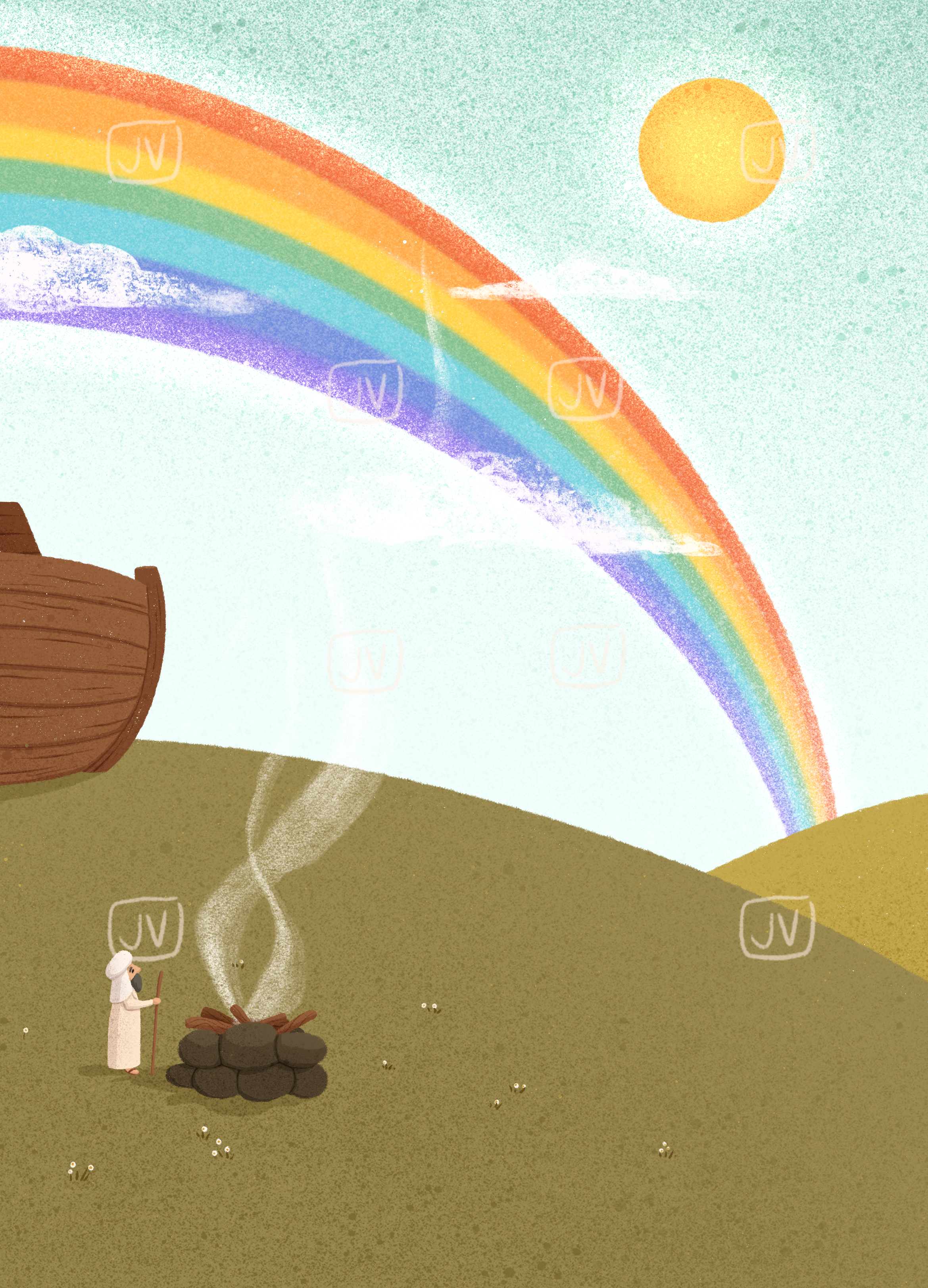
Artist: Jenske Visser

Source and License
Based on The Law of Messiah - Torah from a New Covenant Perspective by Michael Rudolph and Daniel C. Juster.
License: CC BY-ND 4.0 (Attribution required, NoDerivatives). CC BY-ND 4.0
Disclaimer: the original content is authored by Rabbi Michael Rudolph and Rabbi Daniel Juster; additional notes or implementation details on this website are not part of their original work and do not represent their views.
Record source: The Law of Messiah - Torah from a New Covenant Perspective - Volume 1 & 2
Copyright note: Copyright © Michael Rudolph and Daniel C. Juster, The Law of Messiah, Torah from a New Covenant Perspective, Volume 1 & 2