BA42
We are to partake of bread and wine with others and with a pure heart in remembrance of Yeshua.
Category: God & Yeshua
Type: Positive
Form: Explicit
Source dataset: New Testament
Uniqueness: Unique
Classical commandment: No
New Covenant Literal Application
Applies to Person Categories: Everyone
 Jewish
 K'rov Yisrael
 Gentile
More explanation about the icons and New Covenant Literal Application
The New Covenant Literal Application Code (NCLA) is an interpretive guide used by the authors to indicate which person categories a mitzvah applies to, and at what level of literal compliance.
Each card above groups one application level such as mandated or optional. The three people icons show whether that application is meant for Jewish, K'rov Yisrael, or Gentile believers, and the male or female symbols show whether it applies to men, women, or both.
This code reflects the authors' interpretive opinion and is provided for prayerful consideration. The icon view is only a visual summary; the detailed codes and source explanation remain available below for careful study.
Detailed codes: GFm - Gentile female, mandated | GMm - Gentile male, mandated | JFm - Jewish female, mandated | JMm - Jewish male, mandated | KFm - K'rovat Yisrael female, mandated | KMm - K'rov Yisrael male, mandated

Bible references
Key NT Scriptures
- 1 Corinthians 11:23-31
- Luke 22:19-20
- Mark 14:22-25
- Matthew 26:26-28
Supportive NT Scriptures
- 1 Corinthians 10:16-17
- John 6:33
- John 6:35
- John 6:48-51
- John 6:53-58
- Luke 24:30
Supportive OT Scriptures
- Genesis 14:18-20
Bible verses copyright: PUBLIC DOMAIN except in the United Kingdom, where a Crown Copyright applies to printing the KJV. See http://www.cambridge.org/about-us/who-we-are/queens-printers-patent

Commentary
Rabbi Michael Rudolph
Matzah is traditionally used at Passover meals ( sedarim ) to remember the unleavened bread the Israelites brought with them out of Egypt, and wine is traditionally used to represent the blood of the lamb that was sacrificed and placed on the doorposts of Israelites’ homes to save their firstborn sons from the angel of death. The matzah eaten by Ashkenazic Jews at their sedarim represents the lamb that was consumed at the original Passover, whereas Sephardic Jews serve lamb as one of the Passover foods for the same reason. Bread and wine have been used as far back as Abraham as elements for sealing covenants. We read in Genesis 14:18-20: “Malki-Tzedek king of Shalem brought out bread and wine. He was cohen of El 'Elyon [God Most High], so he blessed him with these words: "Blessed be Avram by El 'Elyon, maker of heaven of earth and blessed be El 'Elyon, who handed your enemies over to you." Avram gave him a tenth of everything.” At his last seder, Yeshua used matzah and wine in an unusual way but in a way that was consistent with its historical covenantal meaning. We read in Matthew 26:26-28 : “While they were eating, Yeshua took a piece of matzah, made the b'rakhah, broke it, gave it to the talmidim and said, "Take! Eat! This is my body!" Also he took a cup of wine, made the b'rakhah, and gave it to them, saying, "All of you, drink from it! For this is my blood, which ratifies the New Covenant, my blood shed on behalf of many, so that they may have their sins forgiven.” We who are New Covenant believers in Yeshua understand this to be a sacrament intended for us today as well. We call it by various names such as “The Lord’s Table,” “Holy Communion,” “ Seudat Ha-Adon ,” etc., but how often and under what circumstances we are to take it is a matter of debate. It was during a Passover seder that Yeshua lifted the matzah and wine and is quoted in 1 Corinthians 11:24-25 t o have said: "This is my body, which is for you. Do this as a memorial to me"; likewise also the cup after the meal, saying, "This cup is the New Covenant effected by my blood; do this, as often as you drink it, as a memorial to me." Some argue, therefore, that Yeshua meant for us to remember him with bread and wine only during Passover. Others argue that the words “as often as you drink it” mean any time we drink wine, and still others say it simply means “often.”
Copyright © Michael Rudolph and Daniel C. Juster, The Law of Messiah - Torah from a New Covenant Perspective - Volume 3

Drawings
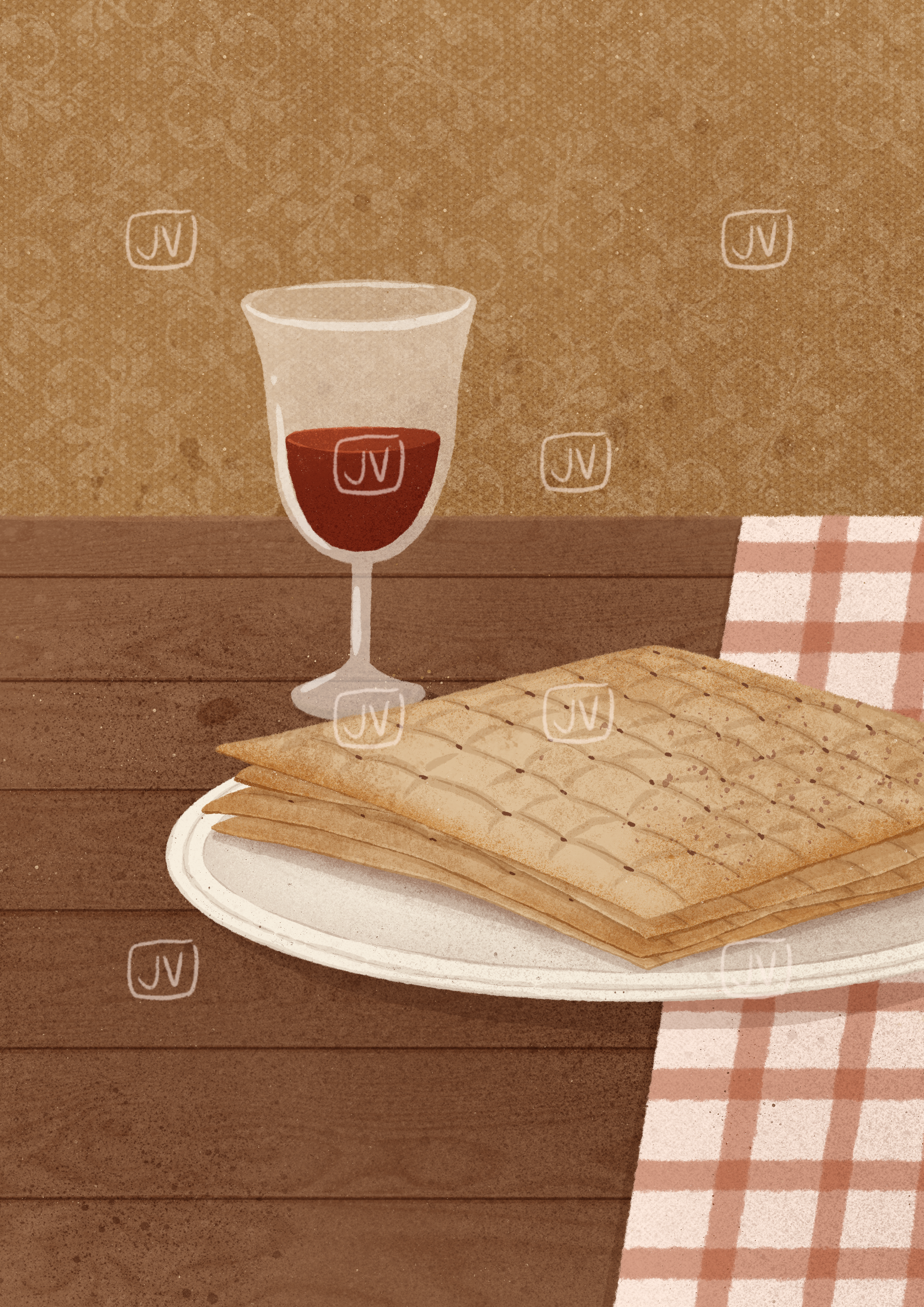
Artist: Jenske Visser

Short Movies
Joshua Aaron - New Covenant

Songs
Sidewalk Prophets - Come to the table
Stephen McWhirter - Jesus, we repent
Selah - O the blood
Big Daddy Weave - Redeemed

Testimonies
One for Israel - Dr. James Tour

Sermons
John Piper - Why and How We Celebrate the Lord's Supper

Source and License
Based on The Law of Messiah - Torah from a New Covenant Perspective by Michael Rudolph and Daniel C. Juster.
License: CC BY-ND 4.0 (Attribution required, NoDerivatives). CC BY-ND 4.0
Disclaimer: the original content is authored by Rabbi Michael Rudolph and Rabbi Daniel Juster; additional notes or implementation details on this website are not part of their original work and do not represent their views.
Record source: The Law of Messiah - Torah from a New Covenant Perspective - Volume 3
Copyright note: Copyright © Michael Rudolph and Daniel C. Juster, The Law of Messiah - Torah from a New Covenant Perspective - Volume 3