N3
We are to help our neighbor who is in need.
Category: Neighbours & Brothers
Type: Positive
Form: Explicit
Source dataset: Old Testament
Uniqueness: Unique
Classical commandment: Yes
New Covenant Literal Application
Applies to Person Categories: Everyone
 Jewish
 K'rov Yisrael
 Gentile
More explanation about the icons and New Covenant Literal Application
The New Covenant Literal Application Code (NCLA) is an interpretive guide used by the authors to indicate which person categories a mitzvah applies to, and at what level of literal compliance.
Each card above groups one application level such as mandated or optional. The three people icons show whether that application is meant for Jewish, K'rov Yisrael, or Gentile believers, and the male or female symbols show whether it applies to men, women, or both.
This code reflects the authors' interpretive opinion and is provided for prayerful consideration. The icon view is only a visual summary; the detailed codes and source explanation remain available below for careful study.
Detailed codes: GFm - Gentile female, mandated | GMm - Gentile male, mandated | JFm - Jewish female, mandated | JMm - Jewish male, mandated | KFm - K'rovat Yisrael female, mandated | KMm - K'rov Yisrael male, mandated

Bible references
Key NT Scriptures
- James 1:27
- James 2:14-17
- 1 John 3:17-18
Key OT Scriptures
- Deuteronomy 15:9-11
- Deuteronomy 22:4
- Exodus 23:5
- Leviticus 19:16
- Leviticus 19:18
Supportive NT Scriptures
- Acts 20:35
- 2 Corinthians 9:12
- Luke 5:30-32
- Luke 6:36
- Luke 14:12-14
- Mark 3:1-5
- Matthew 5:40-44
- Matthew 9:10-13
- Matthew 20:25-28
- Matthew 22:36-40
- Matthew 23:11-12
- Matthew 25:31-46
Supportive OT Scriptures
- Proverbs 19:17
- Proverbs 22:9
- Proverbs 25:21
- Proverbs 28:27
- Psalms 82:4
Bible verses copyright: PUBLIC DOMAIN except in the United Kingdom, where a Crown Copyright applies to printing the KJV. See http://www.cambridge.org/about-us/who-we-are/queens-printers-patent

Commentary
Rabbi Michael Rudolph
This Mitzvah is a natural consequence of the Mitzvah "Loving Our Neighbor, the Stranger, and Even Our Enemy." Scripture requires that we help our neighbor who is in need whether or not we are asked, and whether or not he is a friend. Scripture also commands that help be given even at a cost to ourselves, and therein lies the greatest challenge, which is, "How far must we go to help, and at how great a cost?" Do we give to our neighbor financially to the extent of impoverishing ourselves and our family? Do we rise from our battlefield trench to help our fallen enemy only to get shot ourselves? Throughout life, we encounter situations of these kinds, usually not as extreme, but similar in that helping our neighbor risks something, or takes something away from us with certainty. It may be money, it may be property, it may be time, and it may occasionally be life. There is no biblical formula for when to help, for how much to help, or for whom to help in a given circumstance. We must be tuned into and rely on the Holy Spirit to guide us.
Classical commentators
There are some differences among Maimonides, Meir, and HaChinuch regarding one's obligation to unload and reload an animal that belongs to a Jew and that has fallen as a result of its burden. All agree that both unloading and reloading are obligations but in regard to unloading, Meir states that an elder is exempt because it is beneath the dignity of his status as an elder. HaChinuch agrees with the elder exemption in general, but states that the elder is not exempt if he would have unloaded his own animal under similar circumstances. HaChinuch also states (but Meir does not) that if one encounters a friend and a non-friend with a fallen animal at precisely the same time, one must first assist the non-friend in unloading in order to avoid impure intent. Strangely, in regard to the loading of a fallen animal, Meir and HaChinuch state these obligations somewhat in reverse. Meir states that an elder is exempt from loading and reloading unless he would have done similarly for himself, and he states that one must help a non-friend before a friend. HaChinuch, on the other hand, makes no mention of friends, non-friends, and elders being exempt in the case of loading, whereas Maimonides does not allude to these secondary matters at all. Of significance is that, in the New Covenant Scriptures, Matthew 23:11 and 20:26-27 , Yeshua speaks against Meir's and HaChinuch's interpretation that the dignity of an elder causes him to be exempt from helping his neighbor with the neighbor's fallen animal. In fact, Yeshua teaches the opposite when He says: " The greatest among you must be your servant " and " Whoever among you wants to be a leader must become your servant, and whoever wants to be first must be your slave! "
Copyright © Michael Rudolph and Daniel C. Juster, The Law of Messiah, Torah from a New Covenant Perspective, Volume 1 & 2

Drawings
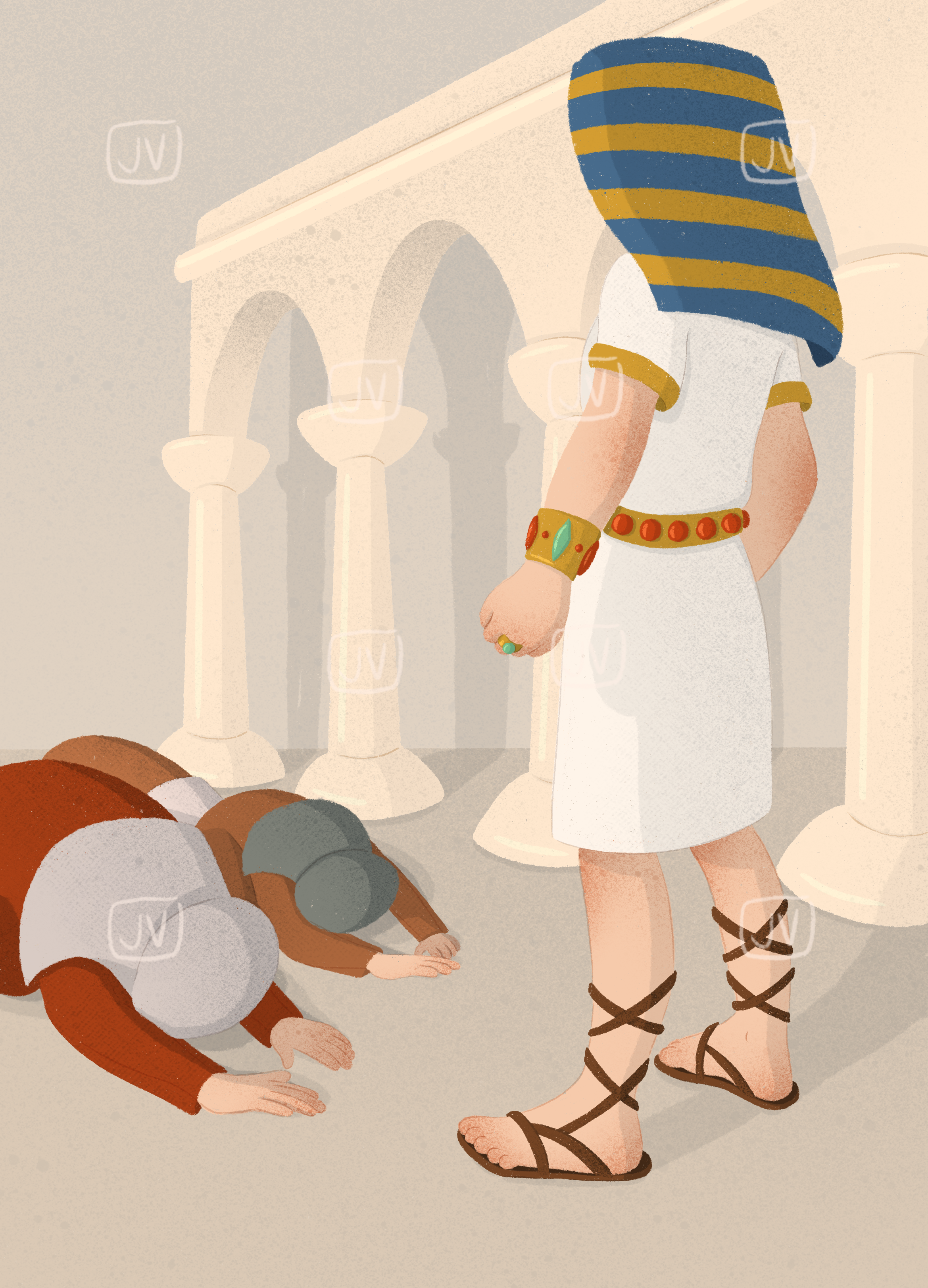
Artist: Jenske Visser
Artist: Jenske Visser

Short Movies
Moving Works - Helper of the Fatherless
Samuel loves Jesus and loves children, so God used him in a very big way.

Movies
Lionsgate - White Bird
From the best-selling author of Wonder, the book that sparked a movement to “choose kind,” comes the inspirational next chapter. In White Bird, we follow Julian (Bryce Gheisar), who has struggled to belong ever since he was expelled from his former school for his treatment of Auggie Pullman. To transform his life, Julian’s grandmother (Helen Mirren) finally reveals to Julian her own story of courage — during her youth in Nazi-occupied France, a boy shelters her from mortal danger. They find first love in a stunning, magical world of their own creation, while the boy’s mother (Gillian Anderson) risks everything to keep her safe. From director Marc Forster (Finding Neverland and Christopher Robin), screenwriter Mark Bomback, and based on R.J. Palacio’s book, White Bird, like Wonder before it, is an uplifting movie about how one act of kindness can live on forever. Great to watch with teenagers!

Testimonies
Moving Works - Cloe
For years, Walt and Annie struggled with infertility, but in a single moment they realized that God was writing a beautiful story for them that was over 20 years in the making.

Classical Commandments
Maimonides
Maimonides (Rabbi Moshe ben Maimon, 12th century) organized all 613 Torah commandments into a structured list. These linked items show where this Law of Messiah commandment overlaps with that classical framework.
Meir of Rothenburg
Rabbi Meir of Rothenburg (13th century, Germany) was a leading Talmudic authority. These reference numbers link this commandment to his halachic rulings.
Source and License
Based on The Law of Messiah - Torah from a New Covenant Perspective by Michael Rudolph and Daniel C. Juster.
License: CC BY-ND 4.0 (Attribution required, NoDerivatives). CC BY-ND 4.0
Disclaimer: the original content is authored by Rabbi Michael Rudolph and Rabbi Daniel Juster; additional notes or implementation details on this website are not part of their original work and do not represent their views.
Record source: The Law of Messiah - Torah from a New Covenant Perspective - Volume 1 & 2
Copyright note: Copyright © Michael Rudolph and Daniel C. Juster, The Law of Messiah, Torah from a New Covenant Perspective, Volume 1 & 2